A Myotis lucifugus, Little Brown Bat.
Geneva Thompson
“This is the hardest part of my job”, says biologist Lisa Bate as she examines a Myotis lucifugus. “Finding nipples on a bat”.
Lisa performs a thorough examination, weighing the bat, taking measurements, examining the wings, establishing sex, estimating age, and identifying the species. This data is recorded and the bat is quickly released back into the night.
This Little Brown Bat is one of the stars of the evening, the first of eight bats collected as part of a routine survey to gather baseline data on bat populations in Glacier National Park. The bat inventory monitoring team is intent on their mission, resembling the little brown creatures that appear sporadically in the night as they flit between the nets and processing station, accompanied by 35 members of the public curious to get a behind the scenes look.

Lisa Bate examines a bat.
Geneva Thompson
The Going Batty Field Trip is an annual event open to the public aimed at sharing an insider’s perspective on this important work in Glacier. Lisa and her team offer a unique educational experience, sharing about all things bats and demonstrating how these surveys are conducted. As the sun sets, the team erects five tall, fine-mesh nets in the hope of capturing a few fuzzy flying friends, then quickly disentangle the netted bats and move them through the processing station. An acoustic monitor is also deployed to capture bat calls in the area. The monitor picks up frequencies that human ears cannot, and the team can later identify what species may have been present based on that data.

A net set to capture bats.
Geneva Thompson
Fifteen years ago, no formal surveys had ever been conducted on bats in Glacier. “We essentially knew nothing about bats”, says Lisa. “Our goal was to learn as much about bats here in the park before White-Nose hit and before we lost an entire species or great numbers of bats. Do basic inventory. What bats do we have here, how abundant they are, how are they distributed across the park? We continue to do that.” Prior to these surveys, only four species of bats were known to reside in Glacier. Now the bat inventory monitoring team has confirmed the presence of ten bat species in the park. The imminent arrival of White-Nose Syndrome makes this baseline data collection on bats in the park all the more important.
White-Nose Syndrome is a disease caused by the fungus Pseudogymnoascus destructans, a cold-loving fungus that can infect hibernating bats. White-Nose Syndrome was first identified when it emerged in the state of New York in 2006. It was quickly recognized as a major threat to bat populations as it swept across the eastern United States, leaving a mortality rate as high as 90-100% in its wake. “It’s a deadly disease”, says Lisa. “It’s not a matter of if it shows up here in Glacier, it’s a matter of when”. White-Nose has slowly made its way westward in North America, thought to be carried by humans on contaminated clothing or gear, wiping out millions of bats along the way. The disease has now been confirmed only two counties away from the eastern border of Glacier National Park, where it was discovered in Azure Cave, the largest known hibernaculum of Little Brown Bats west of the Mississippi. 98% of Little Brown Bats roosting there were killed by the disease.

A bat with white-nose syndrome
USFWS
The impacts of White-Nose Syndrome are alarming, and such a significant loss of bat populations has a major impact on ecosystems. “They’re an integral part of all of our ecosystems”, says Lisa. “In the U.S. alone it is thought that bats save farmers $32 billion a year because of the insects and pests that they eat. Birds eat insects during the day and bats pick that up at night. Our biggest concern here, anywhere, is if you lose massive numbers of bats, that has ripple effects not only on foraging on insects, but they also provide food to weasels, to owls, hawks…there would be a huge ripple effect if we lost that food resource for them too.”
Fortunately, not all hope is lost. Thanks to the groundbreaking work of biologists across the country, the first vaccine for White-Nose Syndrome has been developed, and trials of the vaccine began in Glacier this summer. 150 bats were captured at roosts in St. Mary, half of which were given an oral vaccine for White-Nose Syndrome, and the other half were given a placebo. Each bat in the sample was given an implanted transponder, called a ‘PIT Tag’, with a unique ID so the team can return to the same roost sites over a number of years to monitor survival rates. “We’ve got biologists and scientists from all over the country coming to Glacier to help us with this project”, says Lisa. “I’ve never seen a project develop this fast, and we’re super excited about it”.

A bat’s age can be estimated by looking at its teeth.
Geneva Thompson
The team’s dedication to this work and to protecting Glacier’s bats, despite an unknown future, is inspiring. Thanks to Glacier Conservancy funding, Lisa and her team have the support needed to continue important data collection and research on bats in Glacier and monitor for White-Nose Syndrome in the park. This research has been crucial to gathering baseline data on bats in the park prior to the arrival of White-Nose Syndrome so that the impacts of the disease can be monitored in Glacier.
Thank you for your support for this project and so many other vital projects and programs in Glacier National Park!
If you would like to learn more about bats in Glacier and the work of the bat inventory monitoring team, check out the Headwaters Podcast, Season 4, Episode 8.
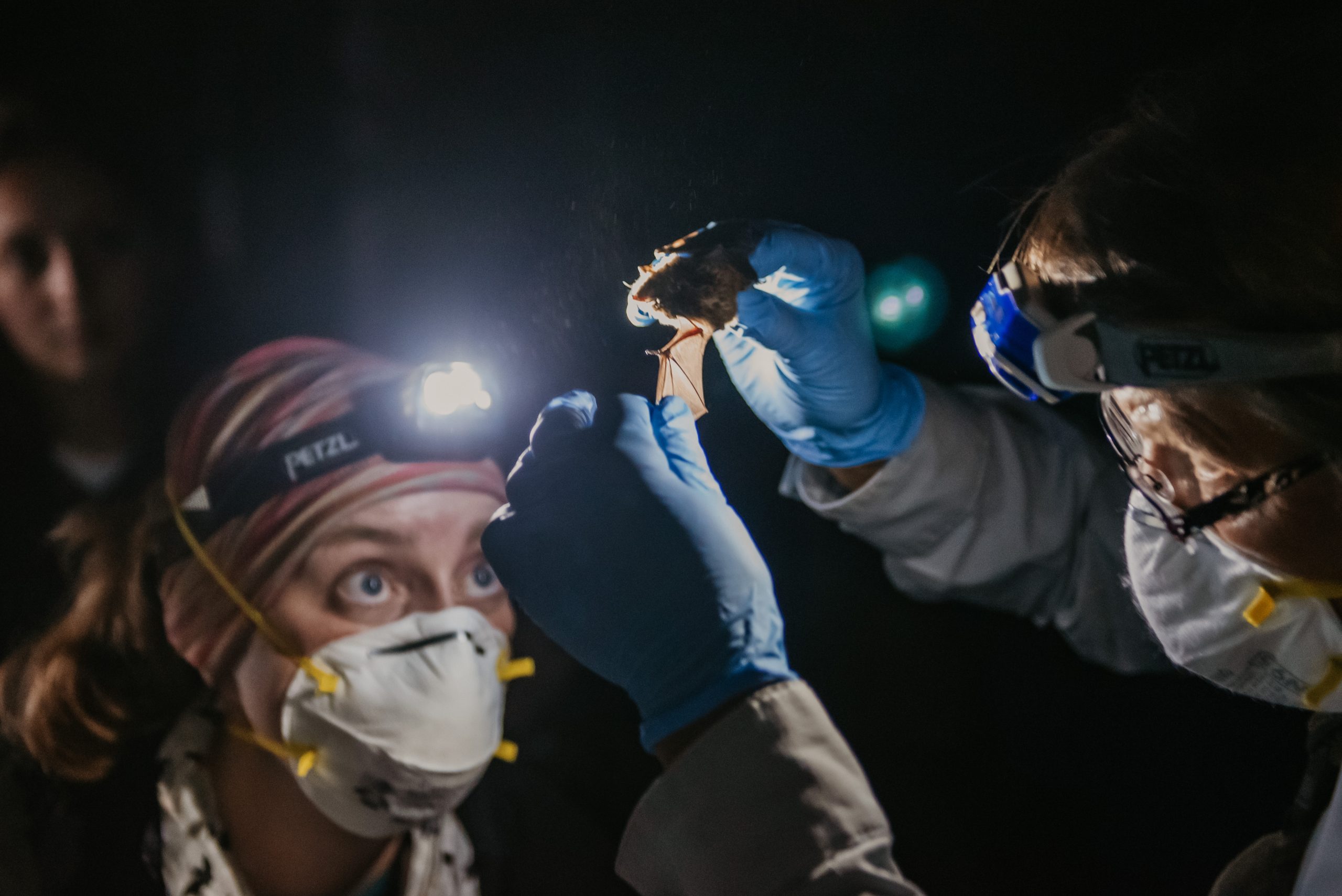
Glacier’s bat inventory monitoring team examines a bat’s wings.
Geneva Thompson
How can you help bats in Glacier?
This project and many other critical projects and programs would not be possible without your donations to the Glacier Conservancy.
Donate now to support important work like this in Glacier National Park!