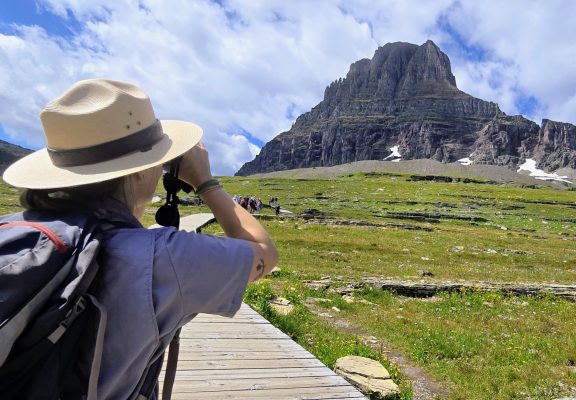
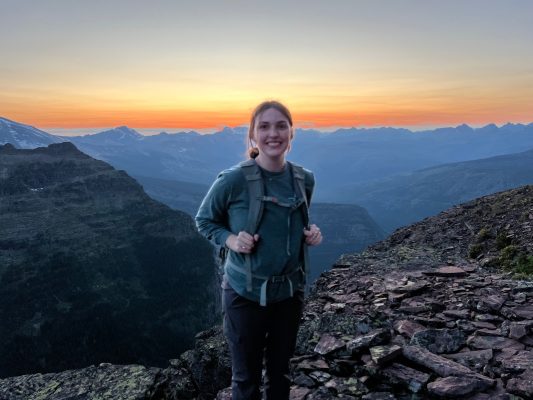
A ranger patrolling near the creek.
When we imagine what it means to preserve and protect Glacier National Park, we might think of towering peaks, magnificent wildlife, or delicate alpine ecosystems. We may picture the planting of saplings, caring for trails, or collection of scientific data. While all these projects play an important role, there is another resource of Glacier’s that needs protecting — its people.
“It’s easy to forget that the staff of the national park are also one of the resources we’re trying to protect,” explains Liz Rael, Glacier’s Employee Engagement Officer.
Rael, along with Deputy Chief Ranger Micah Alley, helps to facilitate the park’s mental health initiative, which aims to provide critical support to park staff through access to mental health professionals.

Search and rescue rangers prepare for a technical operation.
For Alley, the project began in 2019 when it became clear that his own rangers, who were involved in law enforcement and search and rescue, needed support beyond what they had access to.
“I was really focused on building a wellness program just for our workgroup,” Alley says. “We started doing a lot of research and a lot of training trying to recruit specialists and experts to help us build this program.”
While he may have begun with his workgroup in mind, the addition of Conservancy funds helped to grow the project into a park-wide initiative and provide support to the entire staff community, including both permanent and seasonal employees as well as volunteers.
“Living a seasonal lifestyle is really complex and a lot of the staff didn’t even consider mental health resources as something they could access,” Rael explains. “The goal ultimately is that we have opportunities for anyone in the park, whether it’s a staff member, intern or volunteer that could use the support of a mental health professional, to be able to access them.”

According to the U.S. Naval Institute, first responders suffer from depression and posttraumatic stress disorder at a rate up to five times higher than other workers.
They did this by bringing in a local mental health professional to provide free and anonymous drop-in sessions for any staff member who wants them.
“We’re partnered with one mental health professional in the community who has experience working with other government agencies,” Rael says. “We schedule him to be in the park at least one day a month, and then in the summer at least two days if not more.”
Their hope was that access to these drop-in sessions would help park staff deal with the everyday stressors they face working in such a unique environment, and if needed be a resource for connecting them with longer-term, more comprehensive support.
“The feedback we have gotten has been so overwhelmingly positive,” Alley says. “The fact that there’s this option and this expression of love is incredibly meaningful to the staff.”

Firefighters work to reduce fuels around populated areas.
Moving forward their goal is to continue expanding the availability and type of services being offered.
“This program is both desired and needed,” Alley says. “We’d like to go deeper. We’d like to have a more diverse collection of providers to be able to better connect with our diverse workforce.”
“I would love for us to have access to more therapists, access to different types of therapy options, and to not limit ourselves as to what else we could do,” Rael says.
Ultimately, their mission is to ensure every member of the Glacier community feels supported and has the resources they need to continue the incredible and difficult work they do caring for Glacier and its visitors.
“This program makes them feel so invested in and cared about,” Rael explains. “Knowing that the community cares enough about them to fund this project really shows just how beloved both Glacier and its staff are to those they serve.”
How can you help Glacier’s Mental Health Initiative?
Donate now to support important work like this in Glacier National Park!