On an overcast winter day in January, Jackson George makes his way through the backcountry of Glacier National Park. It’s not snowing, despite the thick layer of powder that fell the night before, but when his day started the temperature had barely broken 0℉. For those used to Glacier’s summer glow, the landscape would be unrecognizable — a winter wonderland.
Glacier’s remote winter terrain is stunning, but it also presents serious risks, risks that are growing as more people explore the park in colder months. While winter visitation continues to rise, the resources available for critical training, equipment, and rescue operations have not always kept pace. In response, Glacier is working to strengthen its Winter Search and Rescue (SAR) Program, with support from community partners, like the Glacier National Park Conservancy, dedicated staff, and a new Search and Rescue Fund aimed at closing these gaps.
Today George, Glacier’s Wilderness Winter Intern, is joined by one of the park’s law enforcement rangers and a volunteer from Flathead Nordic Backcountry Patrol. Together they make their way through the snow, stopping to make observations, examine the snowpack, and gather details on everything from how strong the wind is, to where the sun has been shining. The information they gather will play an important role in updating the Flathead Avalanche Center Forecasts, a crucial tool for keeping Glacier’s winter visitors safe.
Winter search and rescue
The winter intern position, funded by the Glacier National Park Volunteer Associates, is an important part of the park’s larger Winter Search and Rescue Program, which works to keep winter visitors safe as they visit during Glacier’s most unpredictable months.
“Winter use is increasing in Glacier, whether that’s snowshoeing, skiing, ice climbing, or winter camping,” says Kate McHugh, Glacier’s Wilderness and Wild and Scenic River Coordinator. “While winter users are usually really self-reliant, it’s really important for us to be able to respond to incidents in the park.”
Winter in Glacier can be volatile, with extreme cold and changing avalanche risk, so those who find themselves unprepared can wind up in situations far beyond their capabilities.
“A lot of our visitors can’t imagine how rugged the park is in the winter,” explains District Ranger Brian Drew, who leads the Winter SAR Program. “A simple gear malfunction or a piece of gear that breaks can create an emergency. It can be a life threatening incident with how cold it is.”
Beyond the weather, many other factors contribute to the difficulty of winter rescue situations, including closed roads and limited staffing.
“Our staff is a fraction of what it is in the summer, and that affects how we respond and who responds,” Drew says.

Park Staff and volunteers practice loading a patient into a toboggan.
Engaging community partners
“What’s really special about the Winter SAR program is it is really inter-agency and engages volunteers,” McHugh explains. “We have pretty much every professional snow worker in the surrounding area training with us.”
In early January the park hosted its Winter SAR Training, three days of collaboration with volunteers and partners culminating in an avalanche rescue scenario.
Volunteers from the Flathead Nordic Backcountry Patrol, Flathead County SAR, and North Valley SAR joined BNSF Railway Avalanche Forecasters, and Glacier National Park Rangers to prepare for any winter rescue scenario that might arise in the park.
The inter-agency team tackled everything from avalanche beacon training to operating a toboggan carrying a rescued visitor. Bringing together rescuers from different backgrounds and skill sets allowed them to share knowledge and experience, and build a stronger response team for park visitors.
“I got to share my knowledge and train some of our permanent staff on some of the more nuanced parts of winter backcountry travel, so that we as a whole can become stronger in our ability to manage different types of backcountry recreation,” says George, who helped to instruct the training for the second year in a row.
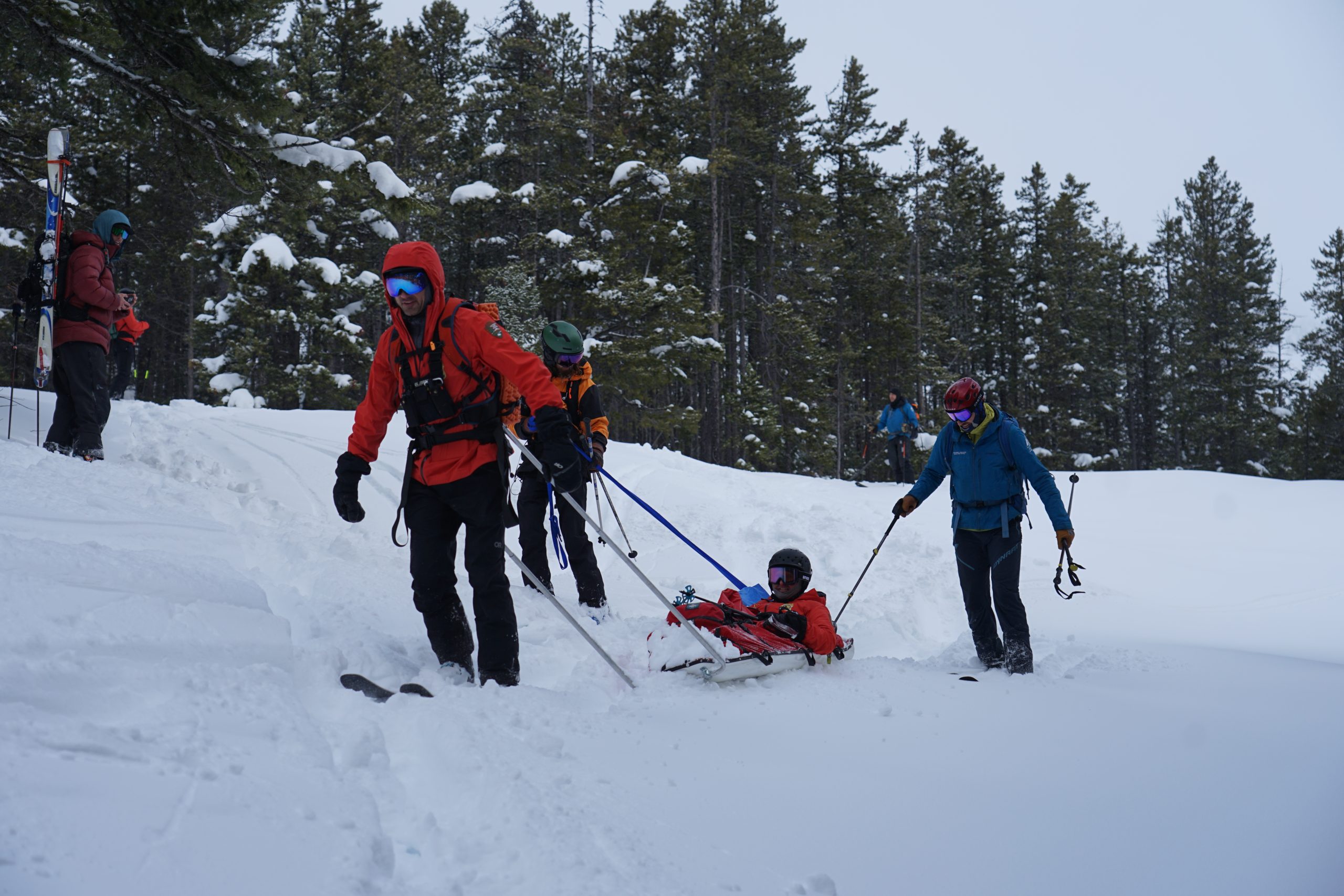
Park Staff and partner volunteers practice moving a patient using a toboggan.
Prevention and education
While the Winter SAR Program works to ensure they would be ready to respond to any rescue situation in the park, their hope is that those situations can be prevented before they begin. Drew, McHugh, and George are all involved in prevention efforts such as connecting with winter visitors and monitoring avalanche conditions throughout the park.
“Going to those areas where a lot of our visitation occurs, getting out there and knowing what those areas and those conditions look like is a big part of our preparation,” Drew explains.
In his role, George monitors conditions throughout the park and helps to inform visitors of the risks they might face on any given day.
“During the winter I am the only staffed wilderness ranger,” George says. “My role is to have a presence on different trails, report both avalanche conditions and general conditions, and just to be someone who can assist anyone in need who is recreating in the park.”
George is also able to connect visitors to resources and share information to help keep them safe. Apps like Avy share important avalanche and weather information and allow visitors to download it for use offline in the park, and the Flathead Avalanche Center shares up to date forecasts so visitors don’t venture into unsafe conditions.
“I like helping people enjoy the park without surprises,” George says. “A lot of visitors don’t really know what to expect, and winter travel can be really challenging, but it’s nice to be someone who is out there and can help make sure visitors have a positive experience.”

Park Staff lead winter search and rescue training.
Search and rescue fund
We’re excited to announce the creation of the Search and Rescue Fund, a way for supporters of this work to help provide critical training, equipment, rescue supplies, and support for response teams. Search and rescue is a critical function to keep park visitors safe, but we need your support to ensure rangers have the resources to carry it out safely and effectively. Consider supporting this important work with a donation to the fund.
How can you help Glacier’s Search and Rescue Program?
The Glacier Conservancy maintains a dedicated fund that directly supports Search and Rescue operations. Your donation helps safeguard visitors and ensures rangers have the tools they need when every second counts.
Donate now to support this important work in Glacier National Park!